Bluetooth Meter

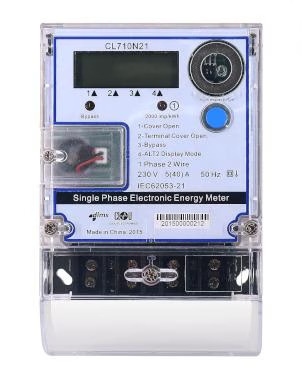
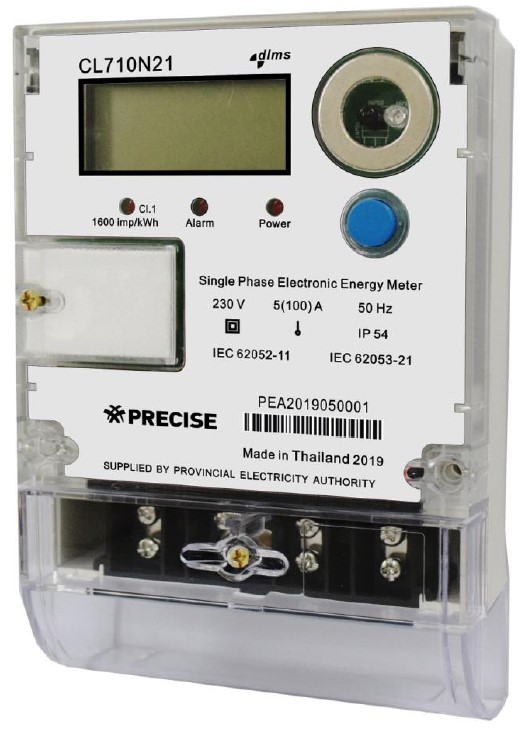
1-Phase Bluetooth Electricity Meter

The meter is a Class 1.0 Accuracy electric energy metering instrument with the high manufacturing technology to realize the measurement and control of active energy, and it supports the standard DLMS/COSEM specification, to realize the interoperability under master station.The meter mainly includes measurement unit, display unit, button unit, real-time clock unit, function of infrared and Bluetooth communication with other auxiliary ports that can be programmable.

TECHNICAL DATA

Full Product Specifications

ModelN21
Communication TypeBluetooth
Normal voltage230VAC
Normal frequency50 Hz
Current rating10(100) A
Measurement ratingClass 1.0 kWh, Class 2.0 kVarh
Operating temperature– 25°C ∼ +60°C
Storage temperature– 40°C ∼ +85°C
Insulation voltage4 kV
Impulse voltage10 kV
Calendar typeGregorian
Display typeLCD – Liquid Crystal Display

Related Products

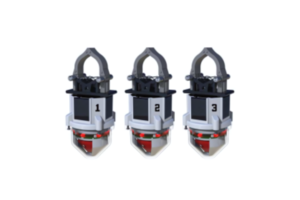
Overhead type Line Fault Indicators is based on the sensor that through Current Transformer (CT) to get the line current signal through smart processor and calculation to judge the short circuit or ground fault. The sensor ablet to warn the user through red LED equipped. It is beneficial for power management to find the fault points and to help in restoring the faulty line faster.
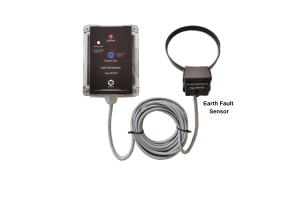
SNV-EFI earth fault indicator, it Widely used in various ring cabinets, high/ Medium or low -voltage switch gear and cable branch box in power system, can accurately and reliably detect the fault section and fault type ofpower grid in the Low/medium voltage network. The use of cable type grounding fault indicator is an efficient way to check cable fault, and is an effective way to improve the operation level of distribution network and theefficiency of fault handling. The design uses electromagnetic induction, and single chip microcomputer control technology to make fault alarm with high accuracy and strong anti-interference ability
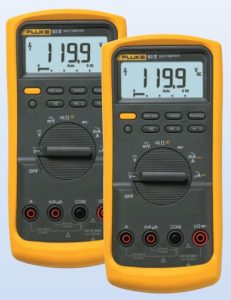
Fluke 83V and 87V Digital Multimeters is For all detailed specifications.Accuracy is given as ±([% of reading] + [number of least significant digits]) at 18 °C to 28 °C, with relative humidity up to 90 %, for a period of one year after calibration. For Model 87 in the 41⁄2-digit mode, multiply the number of least significant digits (counts) by 10. AC conversions are ac-coupled and valid from 3 % to 100 % of range. Model 87 is true-rms responding. AC crest factor can be up to 3 at full scale, 6 at half scale. For non-sinusoidal wave forms add -(2 % Rdg + 2 % full scale) typical, for a crest factor up to 3.